All day for Freddie Gray
A SocialistWorker.org roundup of protests across the U.S. in solidarity with Baltimore protesters and the Black Lives Matter movement.
THE OUTPOURING of anger after the murder of Freddie Gray by six Baltimore cops sparked solidarity protests across the U.S. in late April and early May.
In Chicago, more than 1,000 people marched on less than a day's notice through the city's South Side on April 28 to show solidarity with the Baltimore uprising. Sponsored by the Black Youth Project 100, Black Lives Matter, International Socialist Organization and Feminist Uprising to Resist Inequality and Exploitation, the march was more than double the size of any of Chicago's recent Black Lives Matter protests. Spirited and inspired by the Baltimore rebellion, marchers overwhelmed the police and quickly took to the streets.
Just two weeks after the giant Fight for 15 rallies, the march made a point to stop outside McDonald's to advance the demand for economic justice. Thirty blocks later, marchers shut down a 55th Street intersection for nearly an hour. Along the way, Walmart workers and people on the street warmly welcomed the march, and some joined in.
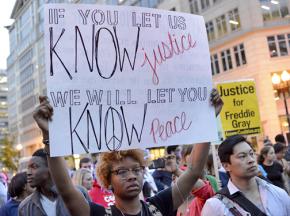
Chanting "We do this for Rekia" among others, important connections between the murder of Freddie Gray and police brutality victims in Chicago were central. Only a week prior, Chicago Police Detective Dante Servin was let off the hook for killing Rekia Boyd. Through organizing for Rekia and others, the Chicago movement has developed an experienced leadership that collaborates across a number of organizations.
Unlike the early debates about how to support the Ferguson uprising, the instinct was for immediate solidarity with Baltimore. The march felt stronger, more confident and more militant.
In New York City, 1,000 people came out on May Day to celebrate the working-class holiday and continue the protests against police violence that shook New York City last year. Protesters marched from Union Square to Foley Square in downtown Manhattan. The police were more accommodating than they were on the night of April 29, when 140 protesters were arrested for trying to march on streets, often violently and without provocation.
"I'm very upset, and I'm tired of police brutality," said 19-year-old college student Destiny Glenn. "Lives are being disregarded. It's just stunning." Aieche Boutantone said she was there to stand up for the rights of immigrants who find themselves unfairly targeted by police and then deported. "We're fighting against the criminalization of our community," Boutantone said. She added she was there in solidarity with the demonstrations in Baltimore "because it can happen to any of us."
In Boston, more than 700 protesters turned out for an April 29 rally at Boston Police Department headquarters to demand justice for Freddie Gray and others murdered by police in Boston and beyond. The protest was called by the new group Mass Action Against Police Brutality, which was formed in the wake of the uprising in Ferguson, Missouri, last year. From the front, organizers called for an indictment of the police officers who murdered Freddie Gray, the release of jailed protesters and dropping of all charges against them, and an immediate end to the state of emergency and curfew.
The protest marked the first time in Boston that families of victims of police brutality addressed protesters from the front of a protest. Wayne Dozier, grandfather of D.J. Henry who was murdered by police in upstate New York in 2010 and whose case was recently dropped by the Department of Justice, recounted the difficulties of losing his grandchild and remarked on the case of Freddie Gray. "Just remember, that 25-year-old boy was somebody's baby, and they broke his back like an animal," said Dozier. "Twenty-five years in this world [means] nothing [to the police]."
Nikea Ramsey, whose brother Burrell "Bo" Ramsey-White was murdered by Boston Police in 2012, described similar heartache. "This pain is real," said Ramsey. "I just had a baby, now three-months-old, [and he's] never going to meet his uncle...We stand with Baltimore, we stand with Ferguson, we stand with Staten Island."
The protesters then marched for several hours through the streets of Boston. As the march passed through Boston's segregated streets, residents leaned out of their windows and cheered, some joining the protest and echoing the chants of "Resistance is justified when Baltimore is occupied."
A second protest called by the new group We Are the Ones and the Tufts Pan African Alliance drew out 200 protesters on May 2. Zig-zagging along a five-mile route through the segregated neighborhoods of Mattapan and Dorchester, one organizer remarked on the state of the neighborhood as she passed her childhood home: "These streets are filthy, and look at all of these abandoned buildings...it looks like when I went to Selma, Alabama."
In Portland, Oregon, the Don't Shoot Portland grouping was the lead contingent in the city's main May Day march, which drew 2,000 people primarily from labor unions and immigrant rights groups. Don't Shoot Portland led the march off the permitted route in order to shut down the bus mall and transit system in downtown Portland for a half hour. The march ended with a speak-out and rally.
About 300 people formed a feeder march that began at Portland State University (PSU) to bring students from the campus to the May Day rally located five blocks north of campus. The initial aim of the feeder rally was to mobilize students against the administration's rollout of a 4.8 percent tuition hike and the deputizing of campus security for the 2015-16 school year. But in the wake of the Baltimore uprising, organizers switched gears to fuse campus-specific demands with demands for an end to police murder.
Anyone in the crowd who wanted to speak out was encouraged to come to the mic, and the march stopped at four locations--PSU's administration building, the Justice Center, the county courthouse and City Hall--for impromptu speeches before marching downtown without a permit to join the main rally at Shemanski Park. As the feeder march, the rally gave a huge cheer, and everyone chanted, "All night, all day, we will fight for Freddie Gray."
In Atlanta, about 100 people protested on May Day at West End Park, a historic Black working-class neighborhood, in honor of the Baltimore uprising and Freddie Gray. Speakers called for an end to racist policing, giving back to the community and building solidarity with one another. The theme of Black Lives Matter, including the lives of Black women and Black queer and trans people, carried through the event.
A Libyan-American woman expressed her solidarity with Black Lives Matter by saying that racial profiling, the prison-industrial complex and the New Jim Crow needed to end and that social change is necessary in this country. A local African American educator spoke about the need for better education in Black communities, and she lamented that Black people who merely appear to be "out of place" warrant some sort of suspicion by the state.
In Smyrna, Georgia, a suburb of Atlanta, the brother of Nicholas Thomas, a young African-American man killed in Cobb County while at work, joined about 150 activists for a protest at Jonquil Park on May 3. Also in attendance was the partner of Anthony Hill, who was gunned down by police completely unclothed.
Protesters marched to Cumberland Mall where they staged a die-in and speak-out to condemn the racist violence facing African Americans. "We don't want it to happen to your families, but that's the reality that we live in," said one protester addressing shoppers. One woman walked off her job to join the action.
In New Paltz, N.Y., students at State University of New York-New Paltz held a May Day rally on campus in solidarity with protesters in Baltimore and around the country. Members of the Black Student Union (BSU), the New Paltz Feminist Collective, Students Against Mass Incarceration and the International Socialist Organization gathered on campus to denounce the militarized police actions in Baltimore and to speak out against racism and Police brutality.
BSU member Jordan Taylor told the crowd: "We saw the civil rights movement and the Black Power movement of the 20th century fight for equality and basic rights...This fight has been going on for decades and longer. It's our generation's turn to move the struggle forward...We should be the last generation to be fighting this."
As the speakers took turns at the mic, a variety of views about how the movement can best move forward emerged. A vibrant discussion of tactics like nonviolence began to take shape, with some putting forward the idea that only through nonviolent means can the Black Lives Matter movement win enough sympathy to win its demands. Others defended the idea that self-defense is a basic human right and that there is no equivalency between the broken windows of a CVS pharmacy and the broken spine of Freddie Gray.
But there was broad agreement that we need to strengthen campus groups fighting racism and to make common cause with other struggles against oppression and for economic justice, such as the fight for a $15 minimum wage.
In Denver, Colorado, a group of nearly 300 people congregated outside of the Van Cise-Simonet Detention Center downtown on April 29 to show solidarity with the uprisings in Ferguson and Baltimore, as well as the struggle against state repression in Mexico, particularly Ayotzinapa. The rally was so impassioned that the march began early, with demonstrators taking the streets.
Unlike previous actions of this nature, the cars held back by the assembly seemed to rally in solidarity, with people behind the wheel parking their cars to enthusiastically join in the chanting until the streets cleared so they could proceed. The group began to march towards the Capitol Building, prompting a response that could only be described as disproportionate. As eight helicopters hovered overhead, about 10 police motorcycles began to corral the protest while dozens of police cars and SUVs took up positions along the route.
As the march made its way to the capitol via Civic Center Park, it was again harassed by police motorcycles and men in camouflage body armor bearing rifles, canisters of pepper spray and batons. Two International Socialist Organization members were directly pepper sprayed, and one was assaulted by a police officer--for no other reason than filming the arrests of other activists.
One officer in the line of motorcycles lost his balance while trying to prevent protesters from stepping into the street and fell. To save face, the officers near him grabbed the nearest demonstrators and began to make arrests based only on their proximity to the cop who lost his balance. In the ensuing chaos, the police maced the crowd liberally, including a 12-year-old boy who was there with his parents. The demonstrators responded by chanting, "This is a peaceful protest, no weapons allowed."
After a half hour or so, when those who had been maced had recovered somewhat, the demonstration regrouped in the park and decided to make its way down to the 16th Street pedestrian mall.
In Seattle, two groups--Outside Agitators 206 and Women of Color for Systemic Change--each held rallies on May 2 in solidarity with Baltimore. Starting several miles from one another, organizers decided to bring the marches of about 100 each together at a large intersection on Martin Luther King Blvd. No less than 30 bike cops "escorted" both marches at all times.
At one point, the cops tried to stop the march heading south by blocking the way with their bikes. Preparing to be pepper sprayed, several younger marchers pushed to the front, asking the officers present if they were criminals and if their lives mattered. After several tense moments, the police backed down.
Further along the march, police in riot gear blocked entrances to the highway. The crowd responded by chanting, "We don't see no riot here, take off your riot gear." The two marches reached each other, and a speak-out was held at the intersection. Children as young as five years old spoke about how they felt when they learned of the deaths of Freddie Gray and Mike Brown and the fear they feel living with Black skin in a racist society.
In Oakland, California, more than 100 people showed up to convert the lawn in front of City Hall into a memorial garden for Black lives stolen by police. The BlackOut Collective as part of the #BlackSpring national day of action spearheaded the action.
Participants assembled paper-and-wood flowers bearing the faces of victims of police murder, such as Alan Blueford, Freddie Gray and Rekia Boyd, then formed a circle and used spades and trowels to plant the symbolic flowers, along with living ones, in the grass. More flowers were set aside for protesters to take away with them and plant in "spaces of resistance."
As the flowers were being assembled, other activists made stencils or held signs. Many signs expressed sympathy with the rebellion in Baltimore with the statement, "I mourn broken lives, not broken windows."
Alternating with music to keep spirits high, speakers made connections between Baltimore, Ferguson and Oakland. Cat Brooks of the Anti-Police Terror Project set the tone for how to understand the meaning of the murder charges, announced one day prior, against the cops who killed Freddie Gray. The charges represent "the state acting in its own interests" to forestall further rebellion, explained Brooks, but that when "so many of us, especially Black and Brown...don't believe we can change anything," the movement needs to take the charges as victories and build on them.
In Austin, Texas, some 200 protesters marched on May Day, gathering at Palm Park and then heading toward downtown while chanting "Whose streets? Our streets!" and "Black Lives Matter."